
Cities are evolving faster than ever before. Rapid urbanization, population growth, and technological advancements are changing how people live, work, and travel. To address these challenges, governments and developers around the world are investing in smart cities—urban environments that use technology, sustainable infrastructure, and intelligent planning to improve the quality of life for residents.
Smart cities integrate digital technologies with transportation, energy, healthcare, public services, and real estate to create efficient, connected, and environmentally friendly communities. These developments not only improve everyday living but also attract businesses, investors, and skilled professionals.
From Dubai and Singapore to Seoul and Amsterdam, many cities are leading the way in smart urban development. Pakistan has also begun adopting smart city concepts through modern residential projects. This article compares some of the world's leading smart cities and explores the features that make them attractive for residents and investors.
What Is a Smart City?
A smart city uses technology and data to improve urban services, infrastructure, and sustainability. Instead of relying only on traditional systems, smart cities use digital solutions to manage transportation, utilities, security, communication, and public services more efficiently.
The goal is to create cities that are:
- More efficient
- Environmentally sustainable
- Safer
- Better connected
- Economically competitive
- Comfortable for residents
Smart city planning combines innovation with long-term urban development.
Key Features of a Smart City
Although every smart city is unique, most share several important characteristics.
These include:
- High-speed digital connectivity
- Smart transportation systems
- Intelligent traffic management
- Renewable energy solutions
- Energy-efficient buildings
- Smart security systems
- Digital public services
- Sustainable infrastructure
- Green spaces
- Efficient waste management
These features improve daily life while supporting economic growth.
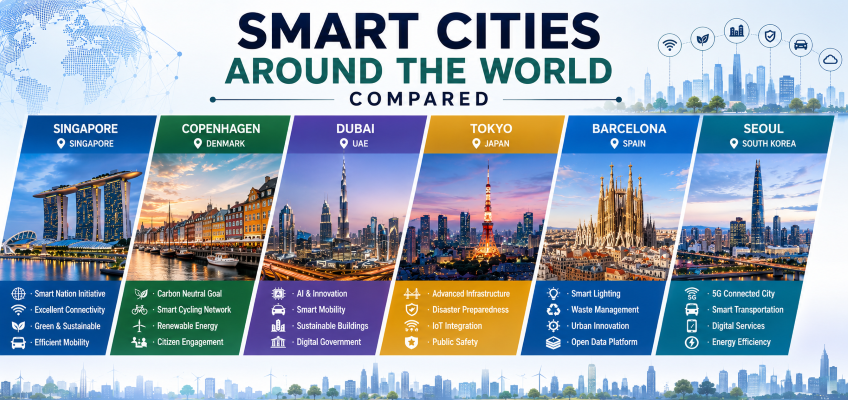
Dubai, United Arab Emirates
Dubai has become one of the world's leading smart cities through its focus on digital transformation and modern infrastructure.
Some of its smart initiatives include:
- Smart government services
- Intelligent transportation systems
- Digital payments
- AI-powered public services
- Smart traffic management
- Smart police services
- High-speed internet infrastructure
The city's real estate developments increasingly include smart home technology and sustainable building practices.
Singapore
Singapore is widely recognized as one of the world's smartest cities.
Its urban planning focuses on efficiency, sustainability, and technology.
Key features include:
- Digital public services
- Smart transportation
- Water conservation
- Green architecture
- Public Wi-Fi
- Intelligent healthcare systems
- Energy-efficient infrastructure
Singapore's integrated planning has created one of the world's most livable urban environments.
Seoul, South Korea
Seoul combines advanced technology with modern urban living.
The city offers:
- Smart public transportation
- High-speed internet
- Digital government services
- Smart healthcare
- AI-based traffic systems
- Intelligent waste management
Technology plays an important role in nearly every aspect of daily life.
Amsterdam, Netherlands
Amsterdam focuses on sustainability while embracing digital innovation.
The city promotes:
- Smart energy systems
- Electric transportation
- Cycling infrastructure
- Green buildings
- Renewable energy
- Smart water management
Its environmentally friendly approach has become a model for urban development worldwide.
Copenhagen, Denmark
Copenhagen consistently ranks among the world's most sustainable cities.
Its smart initiatives include:
- Bicycle-friendly transportation
- Renewable energy
- Smart lighting
- Carbon reduction programs
- Green public spaces
- Energy-efficient buildings
The city aims to become one of the world's most environmentally responsible urban centers.
Tokyo, Japan
Tokyo combines advanced technology with highly efficient public infrastructure.
Key smart features include:
- Intelligent transportation
- Smart rail systems
- Robotics
- AI-powered public services
- Disaster management technology
- High-speed digital networks
Its efficient planning supports one of the world's largest urban populations.
Barcelona, Spain
Barcelona has successfully integrated technology into city management.
Smart initiatives include:
- Intelligent parking systems
- Digital public transportation
- Smart street lighting
- Environmental monitoring
- Waste management technology
The city's digital infrastructure continues improving public services.
New York City, United States
New York continues adopting smart technologies to improve urban living.
Major initiatives include:
- Smart traffic systems
- Digital public services
- Intelligent energy management
- Smart building technologies
- Public Wi-Fi
The city combines modern innovation with one of the world's largest business environments.
London, United Kingdom
London continues investing in digital infrastructure and sustainable urban planning.
Its smart city initiatives include:
- Contactless transportation
- Smart energy systems
- Public Wi-Fi
- Digital government services
- Sustainable buildings
- Environmental monitoring
Technology continues improving both public services and quality of life.
Capital Smart City, Pakistan
Pakistan has entered the smart city movement through projects such as Capital Smart City near Islamabad.
The development includes:
- Smart infrastructure
- Digital community management
- Modern road systems
- Educational institutions
- Healthcare facilities
- Commercial districts
- Sustainable planning
It represents one of Pakistan's first large-scale smart residential developments.
Smart Features in Modern Pakistani Communities
Several Pakistani housing societies have started incorporating smart city concepts.
These include:
- Digital security
- Fiber optic internet
- Smart utility management
- Gated security systems
- Community management applications
- Sustainable infrastructure
Developers continue introducing new technologies to improve residential living.
Smart Transportation
Transportation is one of the most important components of a smart city.
Modern systems include:
- Intelligent traffic signals
- Public transportation integration
- Electric vehicle charging stations
- Digital parking management
- Real-time traffic monitoring
These technologies reduce congestion while improving mobility.
Sustainable Infrastructure
Smart cities prioritize environmental sustainability.
Important initiatives include:
- Solar energy
- Rainwater harvesting
- Waste recycling
- Green building construction
- Smart irrigation
- Energy-efficient lighting
These systems reduce environmental impact while lowering operating costs.
Smart Security
Modern cities increasingly rely on technology to improve public safety.
Security features often include:
- CCTV surveillance
- Facial recognition systems
- Digital emergency response
- Smart visitor management
- AI-assisted monitoring
These technologies create safer urban environments.
Digital Government Services
Smart cities simplify public services through online platforms.
Residents can often access:
- Utility payments
- Government applications
- Public records
- Tax services
- Healthcare appointments
Digital services reduce paperwork while improving efficiency.
Healthcare Innovation
Technology is transforming healthcare delivery in smart cities.
Innovations include:
- Telemedicine
- Electronic health records
- Smart hospitals
- AI-assisted diagnostics
- Digital appointment systems
These services improve healthcare accessibility.
Education in Smart Cities
Modern educational systems increasingly use technology.
Smart cities support:
- Digital classrooms
- Online learning
- High-speed internet
- Technology-enabled schools
- Research centers
Access to quality education attracts families and businesses.
Why Investors Prefer Smart Cities
Smart cities offer several investment advantages.
These include:
- Strong infrastructure
- High property demand
- Better rental opportunities
- Long-term appreciation
- Business growth
- Sustainable development
Modern infrastructure increases the value of residential and commercial properties.
Challenges Facing Smart Cities
Despite their advantages, smart cities also face challenges.
Common issues include:
- High development costs
- Data security concerns
- Technology maintenance
- Infrastructure investment
- Population growth management
Governments continue working to address these challenges through innovation and planning.
Future of Smart Cities
The next generation of smart cities is expected to include:
- Artificial intelligence
- Autonomous transportation
- Smart energy grids
- Digital property management
- Renewable energy expansion
- Intelligent healthcare
- Smart construction
Technology will continue transforming urban development worldwide.
Final Thoughts
Smart cities are redefining modern urban living by combining technology, sustainability, and efficient infrastructure. Cities such as Dubai, Singapore, Seoul, Amsterdam, Copenhagen, Tokyo, London, and New York demonstrate how intelligent planning can improve transportation, healthcare, education, security, and overall quality of life.
Pakistan has also begun embracing this transformation through projects like Capital Smart City and other modern residential developments that incorporate digital services and sustainable planning. As technology continues to evolve, smart cities will play an increasingly important role in shaping the future of real estate, business, and urban living.
For investors, these developments offer promising opportunities because they attract residents, businesses, and long-term demand. Whether investing locally or internationally, understanding smart city concepts can help identify communities with strong future growth potential.
Frequently Asked Questions
What is a smart city?
A smart city uses technology, digital infrastructure, and sustainable planning to improve public services, transportation, security, energy management, and the overall quality of urban living.
Which country has the most advanced smart cities?
Countries such as Singapore, the United Arab Emirates, South Korea, Japan, Denmark, the Netherlands, the United Kingdom, and the United States are recognized for leading smart city initiatives.
Is Pakistan developing smart cities?
Yes. Projects such as Capital Smart City and several modern housing societies are introducing smart infrastructure, digital services, and sustainable planning concepts.
Why are smart cities attractive for real estate investment?
Smart cities generally offer modern infrastructure, higher property demand, better quality of life, stronger rental markets, and long-term property appreciation.
What technologies are commonly used in smart cities?
Smart cities use high-speed internet, artificial intelligence, digital government services, smart transportation, renewable energy, intelligent security systems, and sustainable infrastructure to improve urban living.